In the modern landscape of facility management, the focus has shifted from mere structural maintenance to the optimization of the indoor environment. Central to this evolution is the monitoring of Carbon Dioxide. While often discussed in the context of global emissions, carbon dioxide plays a pivotal role in the health, productivity, and energy efficiency of smart buildings.
Understanding how to manage this gas is no longer optional for facility managers. With the rise of advanced IoT gateway technology and integrated Building Management Systems (BMS), controlling CO2 levels has become a streamlined process that directly impacts building performance and occupant wellbeing.
What is Carbon Dioxide (CO2)?
Carbon dioxide (CO2) is an odourless, colourless, inert and non-toxic gas. It is predominant in the Earth's atmosphere and is an essential component of the carbon cycle. CO2, produced by the respiration of living organisms, is a necessary resource for plant photosynthesis: living organisms convert oxygen into CO2, and plants convert the latter into oxygen.
It is crucial to develop strategies to reduce CO2 emissions and mitigate their effects on the climate, as the increase in this gas in the atmosphere, mainly due to the combustion of fossil fuels and deforestation, is causing a greenhouse effect and contributing to global warming.
CO2 is a naturally occurring chemical compound that is vital to life on Earth, yet its concentration within enclosed spaces serves as a critical indicator of air freshness and ventilation adequacy.
CO2 Chemical Composition
The CO2 meaning refers to a molecule composed of one carbon atom covalently double-bonded to two oxygen atoms. At standard temperature and pressure, it exists as a colorless, odorless gas. In the context of Indoor Air Quality (IAQ), it is the primary "occupancy proxy" used by engineers to determine if a space is being refreshed with enough outdoor air.
Sources of CO2 in commercial and residential buildings
In most commercial and residential settings, the primary source of Carbon Dioxide is metabolic activity, specifically, human respiration. Every time an occupant exhales, they contribute to the indoor CO2 concentration. Other secondary sources include:
- Combustion: Gas heaters, boilers, or stoves within the building.
- Infiltration: Outdoor air high in carbon dioxide drawn in through windows or vents.
- Off-gassing: Though rare, certain industrial processes within a mixed-use facility can contribute to levels.
Why CO2 Monitoring is Critical for Facility Managers
For those overseeing smart buildings, monitoring carbon dioxide is a matter of both operational efficiency and health compliance. High levels of this gas are a clear signal that the ventilation system is failing to keep pace with the occupancy of the room, leading to "stale air."
The link between CO2, Indoor Air Quality (IAQ), and health
The relationship between CO2 and Indoor Air Quality (IAQ) is direct. When levels rise, it usually indicates a buildup of other pollutants, such as Volatile Organic Compounds (VOCs) and pathogens. Exposure to elevated carbon dioxide levels can lead to:
- Cognitive decline: studies show significant drops in decision-making scores as levels exceed 1,000 PPM.
- Fatigue and headaches: occupants often report "brain fog" or lethargy in poorly ventilated meeting rooms.
- Pathogen spread: high CO2 levels are often correlated with an increased risk of airborne virus transmission due to insufficient air exchange.
UK Standards and Recommended PPM Levels (CIBSE/HSE Guidelines)
In the UK, guidelines from CIBSE and the HSE provide clear benchmarks for parts per million (PPM) concentrations. While outdoor air typically sits around 400 PPM, indoor targets are more stringent:
- < 800 PPM: Considered high-quality ventilation.
- 800 - 1,000 PPM: Acceptable levels for most office environments.
- > 1,500 PPM: A threshold indicating that the HVAC system requires immediate adjustment or the room occupancy must be reduced.
Technical solutions for measuring Carbon Dioxide
To maintain these standards, smart buildings rely on a network of sensors. Selecting the right hardware and ensuring it can communicate with the central Building Management System (BMS) is the foundation of modern building performance.
Types of CO2 Sensors (NDIR, Electrochemical)
Facility managers generally choose between two primary sensor technologies:
- NDIR (Non-Dispersive Infrared): The industry standard for IAQ. These sensors measure how much infrared light carbon dioxide molecules absorb. They are highly accurate, durable, and have a long lifespan (often 10+ years).
- Electrochemical Sensors: More affordable but prone to "drift" over time. These are typically used in budget-conscious residential applications rather than professional facility management.
Connectivity Protocols: LoRaWAN, Modbus, and BACnet
The challenge often lies in BMS connectivity. How do you get data from a sensor in a meeting room to a boiler in the basement?
- LoRaWAN: Ideal for retrofitting existing buildings. It is a long-range, low-power wireless protocol that allows sensors to be placed anywhere without expensive cabling.
- Modbus & BACnet: These are the traditional "wired" languages of smart buildings. BACnet is particularly common for HVAC control, while Modbus is often used for power and gas metering.
- MQTT: A lightweight protocol used to push sensor data to cloud platforms for real-time monitoring.
How Wattsense Optimizes CO2 Management
Wattsense provides the technology to simplify building management by centralizing data from diverse sources. We enable facility managers and integrators to improve building performance, save time, and cut operational costs by making CO2 data actionable.
Centralizing Sensor Data with the Wattsense Bridge
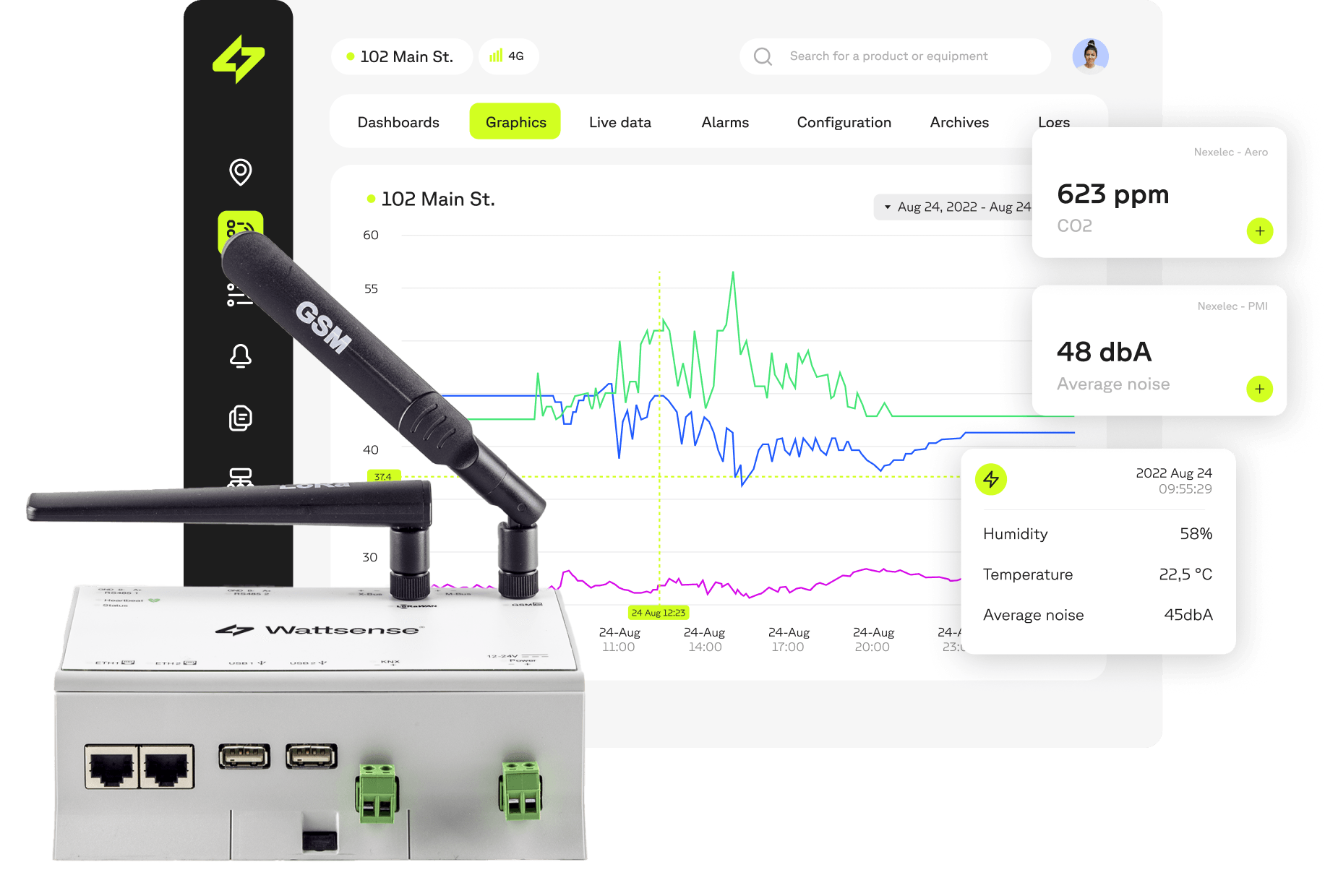
The Wattsense Bridge is our most innovative open, interoperable IoT gateway. It is designed for integrators who need to connect diverse equipment to an on-site supervisor or BMS.
- Plug & Play: Easily connect LoRaWAN CO2 sensors and redirect their data to an existing BACnet or Modbus system.
- Remote Configuration: Manage your gateway settings from anywhere, ensuring sensors stay calibrated and connected.
- Real-Time Insights: Access immediate data to ensure your IAQ never dips below acceptable standards.
Enabling Demand-Controlled Ventilation (DCV) via Tower Control
Tower Control is our "Light BMS" designed for small and medium-sized buildings. It allows for the implementation of Demand-Controlled Ventilation (DCV), which is one of the most effective ways to save energy.
- Automation Scenarios: Set rules so that the HVAC system only increases air exchange when CO2 levels cross a certain PPM threshold.
- Scheduling: Ensure ventilation is active during peak hours while scaling back during unoccupied periods to save costs.
- Dashboards: Visualize carbon dioxide trends alongside energy consumption to prove the ROI of your ventilation strategy.
Data Collection for PropTechs with Tower Lift
For PropTech companies and large-scale property owners, Tower Lift offers powerful cloud connectivity focusing purely on efficient data retrieval.
- Data Historisation: Store years of CO2 data to identify long-term patterns in building performance and health trends.
- API & Webhook Integration: Seamlessly push Indoor Air Quality data to custom apps, tenant dashboards, or ESG reporting tools.
- Unified View: Collect data from electricity meters, water meters, and environmental sensors across an entire portfolio via a single, secure solution.
By integrating these solutions, facility management becomes proactive. Instead of waiting for occupant complaints, you can use the Wattsense ecosystem to ensure that carbon dioxide levels are always optimized, creating a healthier, more efficient, and cost-effective smart building.
The heavy carbon footprint of construction
While the building and public works (BTP) sector is essential to the development and maintenance of our infrastructure, it is also a major source of CO2 emissions: it is estimated that it is responsible for almost 25% of CO2 emissions in France. Reducing the sources of emissions in this sector is therefore an urgent imperative in the fight against global warming. A clear distinction needs to be made between the construction, renovation, and deconstruction stages on the one hand, and the operation of buildings on the other.
Operating buildings and reducing emissions
The operation of a building, whether residential or commercial, is responsible for around 40% of CO2 emissions over the life of the building. To reduce these emissions significantly, a building technical and energy management strategy can be put in place, based on IoT devices, sub-meters, PLCs and energy management platforms, and/or supervisors.
This approach begins with an in-depth analysis of electricity and heating consumption, using data from sensors and meters to detect any energy loss in each room. It then integrates connectivity solutions to centralise data and control heating and lighting equipment, making it easier to implement low-carbon strategies.
Unlock your building performance
Quickly improve energy efficiency, maintenance, and occupant comfort with our connectivity solution for all buildings, whatever their size, condition, or use.