Commercial buildings rely on a number of automation devices, making appropriate control and monitoring essential. That's why a building management system (BMS) is so important. How do we manage the interoperability of all this equipment? The BACnet (Building Automation and Control Networks) protocol is one of the best solutions.
What is the BACnet communication protocol in BMS?
BACnet is an open communication protocol standard that is essential for building management. It enables automation devices made by different manufacturers to communicate with each other, increasing interoperability. It also helps centralize monitoring and control data.
More specifically, there are two versions of this protocol:
- BACnet MS/TP. Less secure, slower, and less scalable than BACnet IP, this older version uses Ethernet and standard serial ports. It also involves data storage and transfer to a controller.
- BACnet IP. Favored for its performance, speed and security, this new version uses IP networks and UDP ports. BACnet IP eliminates the need for third-party controllers, allowing for remote control. It is also compatible with all building management systems, including the Wattsense solution.
BACnet goals
BACnet has two goals:
Ensure the interoperability of automation systems, which is crucial for guaranteeing energy efficiency and optimal building management.
Simplify installations and technical management of buildings.
Firstly, this protocol reduces the need for protocol gateways for communication between devices, controllers, and monitoring tools. This greatly simplifies the installation and use of automation devices.
What's more, the building becomes more scalable. Automation devices can even be replaced with models from other brands since BACnet ensures interoperability.
By using this protocol, property owners can freely choose a manufacturer according to their needs and budget — avoiding any dependence on a particular builder.
How does BACnet work?
Let's look at how this protocol works and, more specifically, its application layer, which manages BACnet objects.
In practical terms, objects represent the equipment and data in a building. Each object has several properties, which store different values. A property can be used to access and control other device characteristics.
BACnet services facilitate the exchange of information between systems using a client/server model. They include reading, writing and event notifications.
Let's take the example of an object associated with a temperature sensor. One of its properties can be the current temperature (current value). The service then allows the client to request the current value from the server, and the server responds to the client.
BACnet advantages
BACnet, a truly international standard, is increasingly used in intelligent buildings and connected infrastructures. This protocol offers several advantages — including flexibility, scalability and interoperability — for more efficient building management.
Whereas manufacturers of automation devices and building management systems used to have their own proprietary protocols, all devices now support BACnet IP. With this open protocol, integrators can develop their solutions according to their customers' needs.
This approach also ensures a healthier competitive edge with better project management. For example, the same building may combine HVAC PLCs, an electrical PLC and a control system of different makes. BACnet then ensures the interoperability of the whole system.
BACnet disadvantages
However, despite its many advantages, BACnet still has some limitations and is not suitable for all uses.
Firstly, its simplicity makes it less suitable for master/slave management. It is notably not suitable for managing endpoint devices (convector fans, lighting, blinds, etc.)
Large-scale interoperability is also an issue. A lot of equipment and data saturate the network. As a result, more complex (and costly) network management systems must be put in place. For example, the BACnet protocol is unsuitable when a single method manages several dozen or even hundreds of small controllers.
Examples of BACnet applications
Let's look at some use cases for the BACnet protocol.
Developed by ASHRAE (American Society of Heating, Refrigerating and Air-Conditioning Engineers), while BACnet is primarily used to automate heating, ventilation and air-conditioning (HVAC) systems, it is also used to automate lighting and security systems.
In these areas, it is particularly appreciated for its role in centralizing management. By extension, BACnet also improves the energy efficiency of the building. It provides optimal and consistent remote control of HVAC and lighting equipment. The security system can also be managed more effectively.
Moreover, BACnet makes it easier to maintain technical installations, and to renew them.
As a result, the BACnet protocol has become essential for the automation and interoperability of building management systems. Particularly for HVAC, electrical and security systems.
BACnet is a symbol of openness that has united manufacturers. It offers greater freedom to property owners and integrators. Security, energy efficiency and occupant comfort are just some of the benefits that this protocol contributes to intelligent building management.
BACnet gateway: simplify uour BMS interoperability
In the complex world of smart buildings, interoperability remains a major challenge. Building Management Systems (BMS) are often fragmented, leaving professionals facing heterogeneous architectures and isolated data. How can these disparate worlds be unified for optimized energy and operational management? The solution lies in a high-performance BACnet gateway. At Wattsense, we've designed a plug & play solution to transform this complexity into an opportunity for performance and simplicity for all building stakeholders.
The connectivity challenge: Why a BACnet gateway is essential for Smart Buildings
The potential of smart buildings is immense, but it is often hindered by the difficulty of enabling communication between equipment and systems that don't speak the same language.
Barriers to interoperability in traditional BMS
Buildings house a multitude of devices: sensors, meters, HVAC equipment, lighting, and more. Historically, these systems have been deployed independently, often with proprietary protocols. This lack of communication creates data silos and makes it difficult to obtain an overall view for control and optimization. BACnet was born from this need: a standard, open communication protocol specifically designed for building automation and control. It allows different pieces of equipment, regardless of their brand or function, to share information in a structured way.
Meeting regulatory requirements
Energy performance is no longer an option; it's an obligation. The french Tertiary Decree and the BACS Decree that is mandatory for the EU, for example, mandate a significant reduction in building energy consumption. To achieve the performance targets for a Class A or B BMS, reliable connectivity and precise energy data collection are crucial. A robust BACnet gateway is the indispensable tool for aggregating this diverse data and making it usable by supervision and reporting systems.
Wattsense: the technical solution for easy and flexible BACnet integration
Wattsense breaks down technical barriers and transforms protocol complexity into operational simplicity for your BMS.
A universal gateway: LoRaWAN, to BACnet and Modbus feature
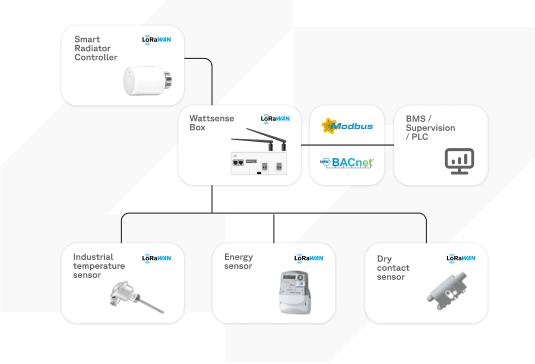
Wattsense technology acts as a true smart hub at the heart of your building. Imagine an interface capable of speaking all languages: it collects data from IoT sensors using low-power protocols like LoRaWAN, interacts with existing equipment via Modbus, and integrates with Cloud platforms via MQTT. Our embedded technology then locally converts these data streams into standardized BACnet/IP objects, ready to be consumed by any supervision system. Gone are the heavy and costly integrations; welcome seamless interoperability.
Technical advantages of our embedded BACnet Functionality
The Wattsense device integrates a complete and high-performance BACnet/IP server with crucial advantages:
- Enhanced Security: With our Bridge solution, data is processed on-site, minimizing risks associated with Cloud exchanges for sensitive information.
- Speed and Reliability: Protocol conversion is instantaneous, ensuring optimal responsiveness of your BMS.
- Remote Configuration and Management: Manage and configure your BACnet gateway and connected equipment remotely, with ease.
- Codec Management: Wattsense is compatible with thousands of sensor and equipment references, facilitating the integration of your existing installed base.
- Intuitive Point Display: Visualize all data points converted into BACnet objects, ready for mapping.
The Wattsense advantage: BMS integration in a few clicks
With Wattsense, you don't just choose a BACnet gateway; you opt for a radically simplified approach to BMS integration.
Ease of installation and time savings for integrators
Integrators know it: commissioning a BMS can be an uphill battle. Our solution is designed with them in mind. Its Plug & Play aspect drastically reduces deployment time, from weeks to just a few minutes. Remote configuration and an intuitive interface allow for quick provisioning of new sensors or equipment, freeing up teams for higher value-added tasks.
Performance and cost control for owners and facility managers
The ease of data collection via our BACnet gateway has a direct impact on building performance and operating costs. Owners and facility managers benefit from a significant reduction in integration costs. By centralizing the control of systems (HVAC, lighting, ventilation...), they can optimize energy consumption, improve occupant comfort, and extend equipment lifespan, all from a single interface.
Frequently Asked Questions (FAQ)
What is a BACnet gateway?
A BACnet gateway is a device that translates data from different communication protocols (such as Modbus, LoRaWAN, or proprietary protocols) into BACnet objects, thereby making equipment interoperable and communicative with a Building Management System (BMS).
Which protocols can be converted to BACnet with Wattsense?
The Wattsense solution can convert a wide range of protocols, including LoRaWAN, Modbus (RTU and TCP), and MQTT, into BACnet/IP objects for simplified integration into your BMS.
Supported Protocols: All the following protocols are simultaneously available with Wattsense: LoRaWAN 1.0, BACnet IP, Modbus RTU, Diematic, M-Bus, Modbus TCP/IP, LPB, KNX.
information seamlessly within a unified building management system (BMS).
Why is it often misspelled as 'Backnet'?
It is very common to see the term "Backnet" used in search queries and project briefs. While "Backnet" is technically a misspelling, it logically stems from how the name is pronounced phonetically by industry professionals.
The correct acronym is BACnet, which stands for Building Automation and Control networks. Despite the spelling difference, when people search for a "Backnet" guide, they are looking for the standardized ASHRAE protocol that powers modern smart buildings.
Request a Demo of Our BACnet Gateway
Ready to simplify your BMS interoperability and unlock the full potential of your smart building?
Contact us today for a personalized demonstration of our BACnet gateway and discover how Wattsense can transform your building management.
BACnet and Wattsense
Explore Wattsense's BACnet-compatible solutions and optimise your building management